01
Tripoli
June 2026
Somewhere in the System
An observation on effort and what it leaves behind.
Ayoub Ahmed
·
Culture & Resistance
·
June 2026
·
9 min read
There were only a few paths in life to choose from. For me, I realized that I did not want to spend my time pursuing a life that is mostly shaped by norms; my driving factor was that I wanted to be part of something larger than myself, to witness change, or at least be standing nearby when it happened. I recognize how that sounds. Perhaps I was resisting the idea that a career had to be the destination. I had already spent years avoiding a career and the traditional systematic steps one is supposed to take to be considered successful; I wanted to feel that work meant something, but that's a story for another margin.
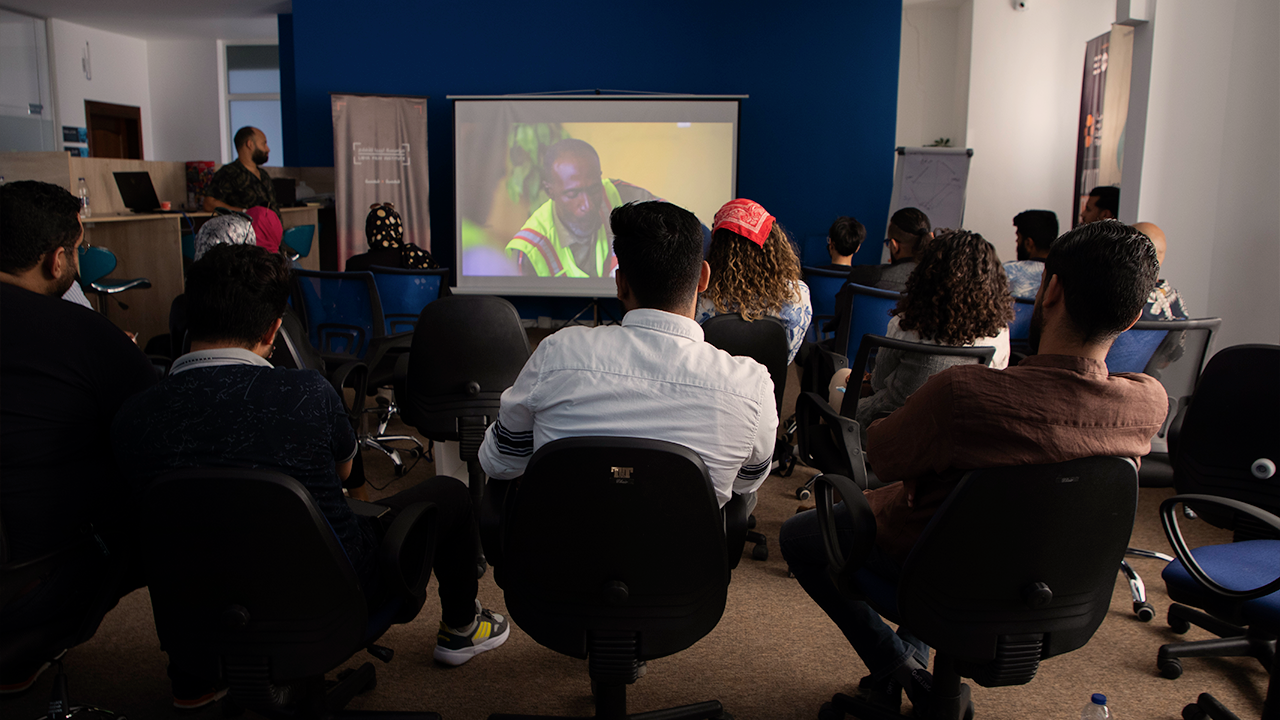
By the end of 2020, I had dedicated most of my time to social work; we tried to revive a cinema culture that was mostly erased during the Gaddafi era and the years after; we screened films in cities that had not seen one in over forty years, shared stories from parts of Libya that would have gone unseen otherwise, organized training and mentored emerging filmmakers to produce their own pieces. Naturally, we thought that we would see people carrying the work after a few years, to screen films within their own neighborhoods, produce their own films, or at least show acceptance of this culture. But we had to stop some of our planned projects, not by choice, but rather due to restrictions, which led us to work more quietly. Attendance at the workshops also thinned; this can be explained by the economic situation, as people have to prioritize what keeps them fed, and film culture cannot be that.
I also think the economy is just one part of the equation. I did not want to mention it at first, but people had stopped expecting anything to change; the country's stability has been deteriorating over the years, and all efforts seem to go into a void. When you spend years asking and hoping, but the situation remains the same, you eventually stop asking for your rights and start asking for electricity and gas instead, and most things beyond that become luxuries. I understand the logic here; you cannot build a film culture on top of that, but the question that stays with me is not about the attendance numbers, but rather the shape of the effort itself.
01 Is the system a closed loop?
I have always felt like I was running in circles, and I never really took the time to explore why, but it kept building up each time I encountered an obstacle until the question was formed, and I could not explain it. When I stumbled upon system justification theory, the work of John Jost and Mahzarin Banaji, I had to take this question seriously. The theory argues that humans are motivated to see the system they live under as fair and natural, even when it works against them; it is a psychological need to reduce uncertainty and feel that solid ground is beneath them. Accepting that the structure you depend on is broken is more threatening than the injustice, which leads to even defending the failing system itself.
I was not surprised by this, as I had always noticed this tendency. What I did find surprising was Kahneman and Tversky's work on loss aversion; it explains that the pain of losing something is roughly twice as severe as the pleasure of gaining something of equal value. That humans choose a familiar problem over an unknown possibility simply because the familiar feels less dangerous.
I followed this thought further, and what I landed on next was not exactly reasoning, but more like trying the ideas on to see what shape they made together.
Thinking that we are wired to defend the system we live in; that we will be in greater pain changing than stalling. Does that mean a deviant idea entering an environment cannot stay new for long? I would say yes; a new idea gets softened by the people around it, reshaped by the norms it was trying to challenge, and eventually it either disappears or becomes something the system can tolerate without actually changing. People would come to watch the screening and participate in a discussion. Then everyone goes home, and nothing changes; the structure that made independent filmmaking nearly impossible in the first place remains exactly where it was.
Here the logic started to close in on me. Our awareness is shaped by the environment, and I am a product of this environment; then what does it mean to challenge it? Am I resisting what shaped me, or is it the environment finding another way to talk to itself through me? When we are part of the system, can we say that individual resistance is resistance? I could not help but think it is the system producing its own friction. The image is not mine, but it describes this very accurately: the way a body produces a fever. The fever feels like it is fighting the illness, but it is the body doing both.
It was not easy to find a way out of this thought. I kept asking whether change could come from the powers that be. If change does not come from individuals, maybe enforcing new rules from above could break the loop. But that argument is tired. A government unable to reflect the collective thought of its people cannot lead in the first place, as it only exists to mirror what is already there. Regulations trying to force something the population has not internalized become fading noise. At this point, I am thinking that we are only left with external shocks the system cannot absorb that can force change. And that felt like giving up. It felt like saying nothing you do matters until some invisible threshold is reached, and you will not know when that is, or whether your effort has a relationship to it happening.
I sat with that longer than I would like to admit, and what I got wrong was the word “closed” as I kept asking whether the system is a closed loop, as though that was a yes or no question. In reality, no system is fully closed; inputs always enter, such as migration, tech, economic shocks, contact with other cultures, and even something as small as a film screening in a city that has not seen one in forty years. The system was never sealed.
I have heard a version of this before, but at the time, I did not understand what it meant. Early on, I told a dear friend of mine that it would be easier to do this work from outside the country, where we could facilitate the screenings online, or to advocate for the culture while not being present on the ground, as this felt safer and would give me more freedom in doing the work. She replied that it was the opposite, that those who can make the change are the ones inside. I did not think much of that for years, and I think she was right; you do not need to stand outside the system to change it.
Some of what we did was picked up differently from what I had pictured. I would hear later that some local organizations were folding films into their programs and sharing written stories with the same structure we had been using, as this culture barely existed before we started. I would not say we take the credit; most of it I cannot trace back to anything we did anyway, and that is sort of the point. It left my hands and kept moving.
I also read about Damon Centola’s work at the University of Pennsylvania, where he tested something that has been a theory for decades but never confirmed. The point at which a committed minority can flip an established norm. What is interesting about his findings is that the threshold is around 25 percent. A consistent and committed minority can tip the norm for everyone. Of course, there are variables to this rule. In a place where people’s neural pathways are shaped by decades of repetition, the threshold is higher, and the system will keep resisting.
While Centola's work is the door I was looking for, the truth is that the tipping point does not only work in directions we would hope for. I normally would want to implement a big screening, or a public activity whose impact can be felt, but now I find myself rejecting that idea before even testing the feasibility of it, assuming a refusal that has not arrived. Somewhere in these years I started to treat the public screening as the unnatural act, and the quiet online one as the reasonable one. I think that's how a norm gets shaped, over time, and I fear that this process carries no inherent moral direction.
I have read this in several places; not all thresholds are equal, and I think what determines the gap is the distance between a proposed norm and the sense of self people carry. When a minority advocates for a change that people already want for themselves deep down, Centola's 25 percent becomes reachable, and the change travels a short distance. When the norm being pushed is one that people do not recognize in themselves, one that emerges from stress and instability rather than from any original desire, the threshold rises.
I want to turn back to what my friend said: that those who can make the change are the ones inside; that's why I understand what she meant by it now. You can only carry something that has not been there and hold it long enough for someone else to pick it up. This reminds me of an anime called On the Movements of the Earth, which lives in this idea, where something is carried forward across people who never met, each holding it a little longer than it was safe to. So individuals are not outside the system, nor are they powerless inside it; they are amplifiers of the things that leak in.
I do not know if the work we did will amount to the kind of change I once imagined, but now I have realized that the work is neither absorbed nor gone; it is probably sitting somewhere in the system. Whether any of it matters today, I honestly cannot tell, but together with efforts from people I will never meet, it seems to accumulate toward an immeasurable threshold.
I have spent most of this essay looking for an answer that would tell me whether the work mattered, and I do not think that answer exists; I do not find this comforting, but maybe that is what I have been resisting all along. Sometimes the truth is enough to keep going.